
Sustainability
Sustainable Development
1. Policy and goals of sustainable management Sustainability policy
The Company is committed to driving business operations towards sustainability according to ESG guidelines, namely economy, society, and environment, within the framework of good corporate governance principles. By conducting business with transparency, fairness, and good ethics. can be checked Under management according to theprinciples of corporate governance Ready to use the United Nations Sustainable Development Framework (Sustainable Development Goals: SDGs) as a guideline for setting sustainable development goals. Taking into account human rights principles and all stakeholders. Participate in the maintenance and management of environmental impacts. As well as promoting the health and well-being of personnel within the organization and the community, along with developing and improving the quality of life of society.
The Company recognizes that climate change is a global sustainability risk that may affect business
operations. The Company is therefore committed to conducting business by considering all impacts and accepting risks arising from rapidly changing situations. And there are management guidelines to avoid or mitigate the impacts that business operations may have on the company, community, society and the environment. To build confidence and trust from all groups of stakeholders. To mitigate the impacts of climate change, which may lead to natural disasters, the Company has established a Business Continuity Plan (BCP). This plan is designed to address emergencies such as floods and severe storms that could restrict office access, ensuring minimal disruption to our operations and safeguarding our business resilience.
The Board of Directors oversees climate change by appointing a sub-committee, that is The Sustainability Committee. The Sustainability Committee manage climate change.
Sustainability Policy
The Company conducts business on the basis of creating growth for all groups of stakeholders. Both in
the economic dimension, the social dimension, and the environmental dimension. Under good corporate governance according to international standards and the Sustainable Development Goals (SDGs) of the United Nations Organization. The company has set sustainability directions in 3 main dimensions under the framework of good corporate governance as follows:
1. Economic dimension
Encourage Thailand’s Economic by supporting SMEs to access source of fund systematically
The Company aims to be a non-financial source of alternative fund for Small and Medium Enterprises (SMEs) which cannot access to source of funds, not being supported by financial institutions even that those SMEs have potential to grow. Such businesses normally require funding outside the system (loan shark) which is a barrier to succeed the Company’s goals in long term.
• Product Innovation for SME
The Company considers developing a variety of financial services to provide total financial solutions especially for SMEs in order that SMEs can grow in accordance with their true capability.
• True Financial Partner
The Company always supports SME side by side and gives them financial advice on funding source in accordance with our core mission to enhance the relationship between the Company and SMEs customers as “True Financial Partner”.
2. Social Dimension
Develop strong society
The Company gives importance to developing strong society according to good governance guideline so that the Company sets clear guidelines for executives and employees to conform as followings; Anti Corruption, Human Right, Accounting operations, Fair labor practices, Health and safety in the work environment, fair business operation and responsibility for business partners, Breaches and supply chain management
3. Environmental Dimension
The current environmental problems which tend to be more serious. As a part of mitigation or impact arising from Human actions, either directly or indirectly. The Company and employees have created a consciousness to protect the world, protect the environment. It is believed that the small dots, when combined together, constitute a group and the power to reduce or mitigate pollution.
Sustainability management goals
The Company is aware of its participation in operations to achieve sustainable development goals. By conducting the business of the company Support the United Nations sustainability goals in the following areas:
The Company recognizes its role in contributing to the achievement of Sustainable Development Goals (SDGs). Our business operations are aligned with and support the United Nations Sustainable Development Goals in the following areas:
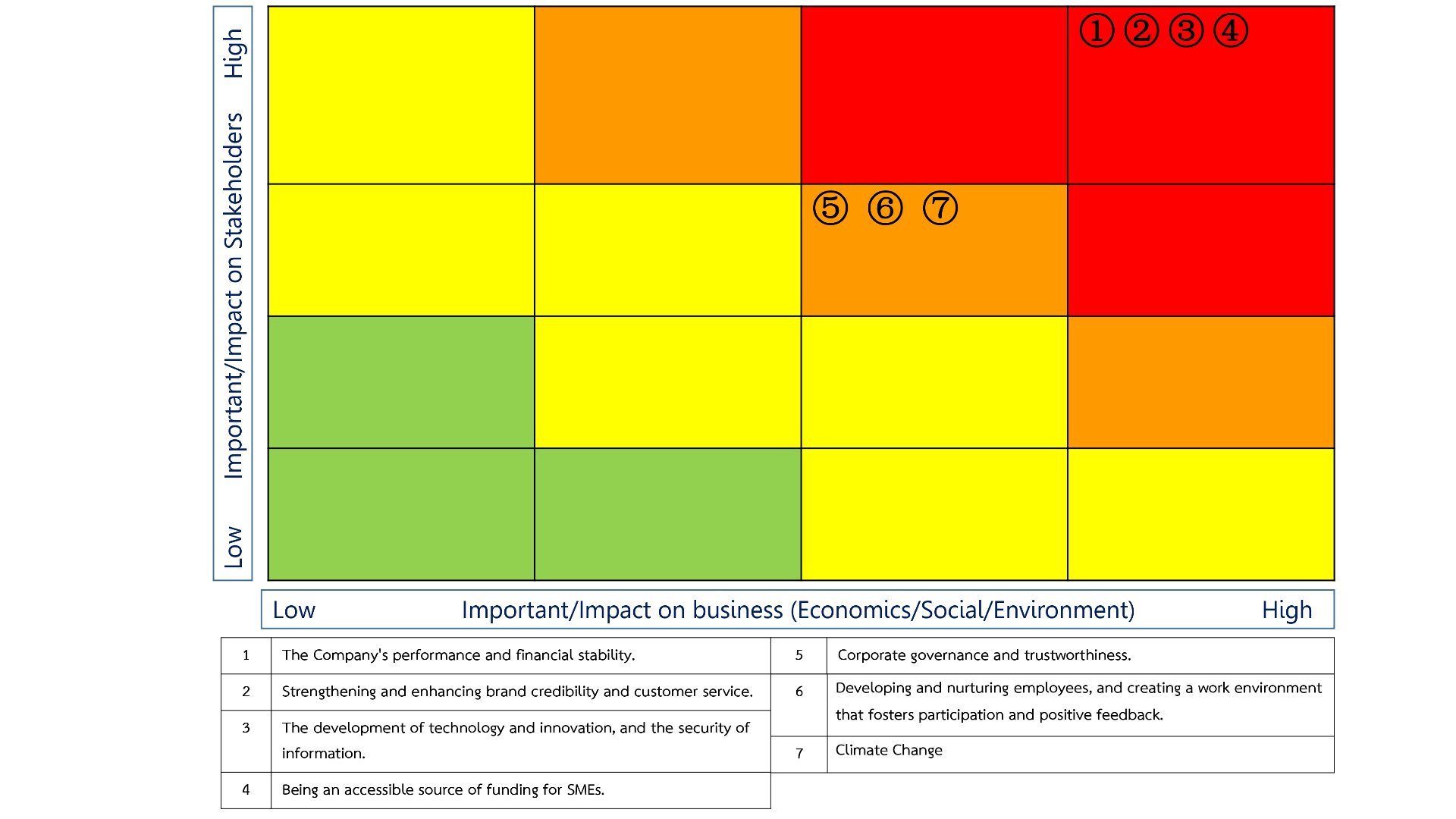
1. Governance Sustainability Framework. There is 1 materiality issue as follows:
(1) Corporate Governance and Organizational Credibility: Supporting SDGs Goals 10, 16, and 17.
2. Economic Sustainability Framework. There are 3 imateriality issues as follows:
(1) Performance and Financial Stability: Supporting SDGs Goals 8, 10, 11, and 12.
(2) Strengthening and enhancing brand Credibility and Customer Service: Supporting SDGs Goals 3, 9, and 16.
(3) Technology & Innovation Development and Data Security: Supporting SDGs Goals 8, 9, 12, and 16.
3. Social Sustainability Framework. There are 2 materiality issues as follows:
(1) Being a source of funding that SMEs can access: Supporting SDGs Goals 1, 8, 10, 11, and 17.
(2) Employee Development, Well-being, and Fostering an Inclusive & Positive Work Environment: Supporting SDGs Goals 3, 4, 5, 8, 10, and 17.
4. Environmental Sustainability Framework. There is 1 important business issue as follows:
(1) Climate Change Management: Supporting SDGs Goals 13 and 17.
The Company has sustainability management goals as follows:
1. Corporate Governance dimension
Corporate Governance and Organizational Credibility: (1) No complaints regarding breaches of Business Ethics or acts of Bribery and Corruption. (2) Certification as a member of the Thai Private Sector Collective Action Against Corruption (CAC). (3) Maintaining an "Excellent" rating in the Corporate Governance Report of Thai Listed Companies (CGR). (4) Maintaining a 5-coin rating in the Quality Assessment of Annual General Meeting of Shareholders. (5) Achieving an FTSE Russell ESG score of not less than 2.75.
2. Economic dimension
1. Performance and Financial Stability: (1) Revenue and net profit are in line with the targets (2) The growth of SME and retail loan portfolios has been achieved according to the targets. (3) Non-Performing Loans (NPLs) are managed effectively within the target. (4) Capital expenditures and investments are utilized according to their intended purposes and are strategically aligned with the Company’s business operations.
2. Strengthening and enhancing brand Credibility and Customer Service: (1) An increase in new potential leads applying for loan services through digital marketing channels. (2) Maintain a customer satisfaction rate of 80% or higher. (3) No complaints arising from the Company’s business operations.
3. Technology & Innovation Development and Data Security: (1) No complaints regarding delays in operations due to system instability. (2) No complaints about a data leak.
3. Social dimension
1. Being a source of fund that SMEs can access: (1) Support 6,000 SME entrepreneurs and achieve a total loan disbursement of 100 billion baht by 2032.
2. Employee Development, Well-being, and Fostering an Inclusive & Positive Work Environment: (1). Achieve an employee engagement score of no less than 80%. (2). Employees are required to complete at least 1 training course per year (3). Decreasing of Turn Over Rate. (4).Provident Fund membership enrollment has increased.
4. Environmental dimension
(1). The Company is committed to achieving Net Zero emissions by 2050. In alignment with the Science Based Targets initiative (SBTi) guidelines, we have established the following emissions reduction targets:
Near-term Target: A 42% reduction in Scope 1 and Scope 2 emissions by 2030, relative to the 2025 base year.
Long-term Target: A 90% reduction in Scope 1 and Scope 2 emissions by 2050, relative to the 2025 base year.
(2). Reduce the use of electricity and tap water at least 5%. Increase the amount of recycle waste at least 5%.
Guidelines for sustainable development
The Company is committed to conducting business under good corporate governance. Taking into account the impact on the economy, society and the environment, the company has set guidelines for developing sustainability and stakeholder participation as follows:
1. To monitor developments, events, changes in related industry by considering factors that impact the business, society and the Company's environment such as the changing weather conditions, financial technology, international sustainable standards e.g.Global Reporting Initiative (GRI), Sustainable Development Goal (SDGs).
2. Accord importance to all stakeholders’ expectations via participation in various activities, for example, conducting survey of customers’ satisfaction, trade partners’ satisfaction, employees’ satisfaction, including taking into consideration the Board of Director’s suggestions in order to improve and meet the expectations of the stakeholders appropriately
Disclosing the policy to all groups of employees and stakeholders as follows
The Company ensures that all policies are effectively communicated to employees and all stakeholder groups through various channels. These key policies include: Code of Business Conduct, Supplier Code of Conduct, Investor Relations Code of Conduct, Anti-Corruption Policy, Whistleblowing Policy, No-Gift Policy (Gifts, Entertainment, and Hospitality), Charitable Contributions and Sponsorships Policy, Political Neutrality Policy, Conflicts of Interest Policy, Securities Trading and Holdings Policy for Directors and Executives, Inside Information Policy, Succession Planning, Environmental Policy, Procurement Policy, Procurement and Supplier Selection Guidelines, Human Resources Management Policy, Audit Committee Charter, Human Rights Policy, Personal Data Breach Management Policy and Procedures, IT Security and Computer Usage Regulations, Information Technology Security Policy and etc.
United Nations SDGs that align with the organization's sustainability management goals :
Goal 1 No Poverty,
Goal 3 Good Health and Well-being,
Goal 4 Quality Education, Goal 5 Gender Equality, Goal 8 Decent Work and Economic Growth,
Goal 9 Industry, Innovation and Infrastructure,
Goal 10 Reduce Inequalities, Goal 11 Sustainable Cities and Communities,
Goal 12 Responsible Consumption and Production,
Goal 13 Climate Action, Goal 16 Peace, Justice and Strong Institutions,
Goal 17 Partnerships for the Goals
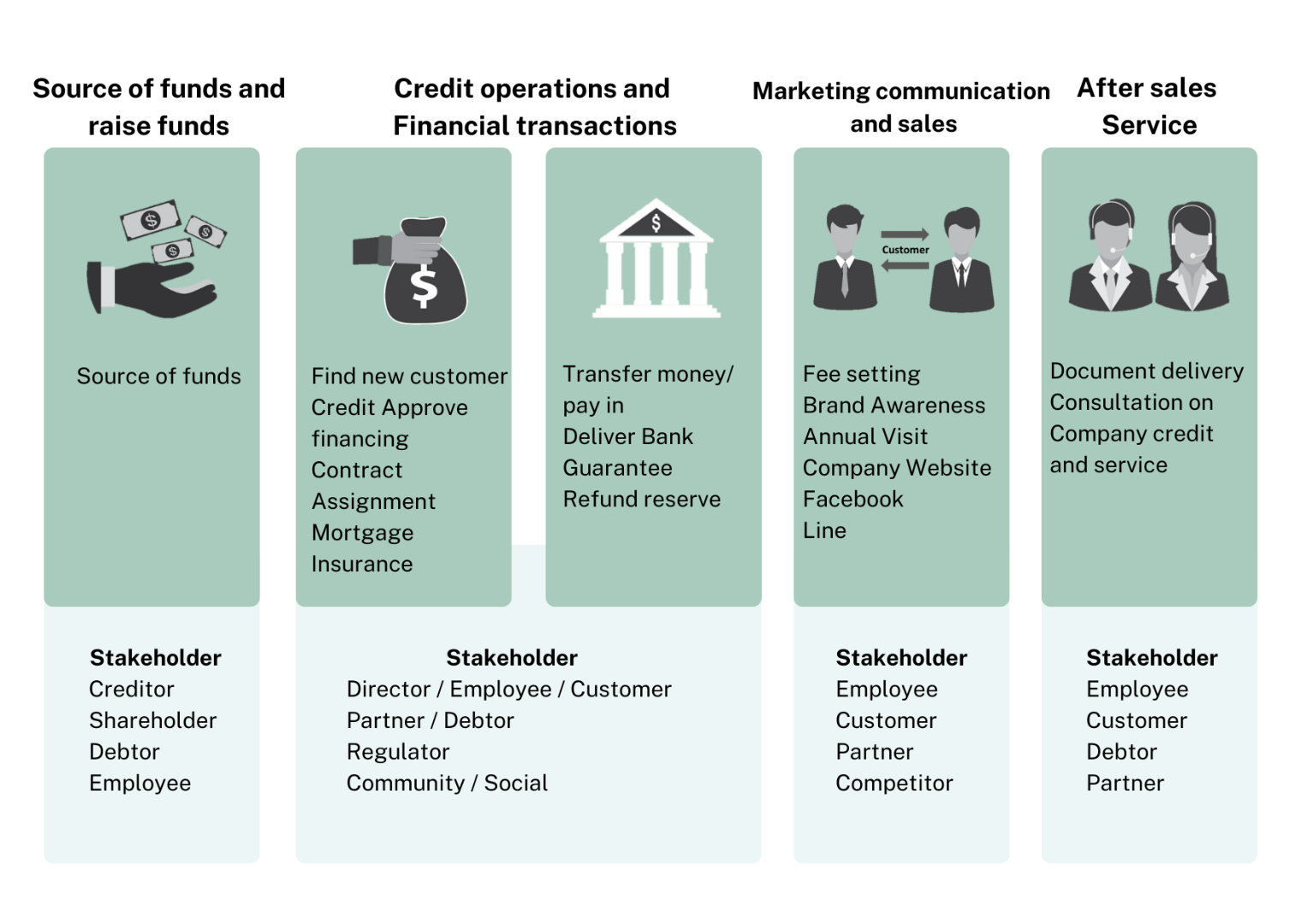
2. Business value chain
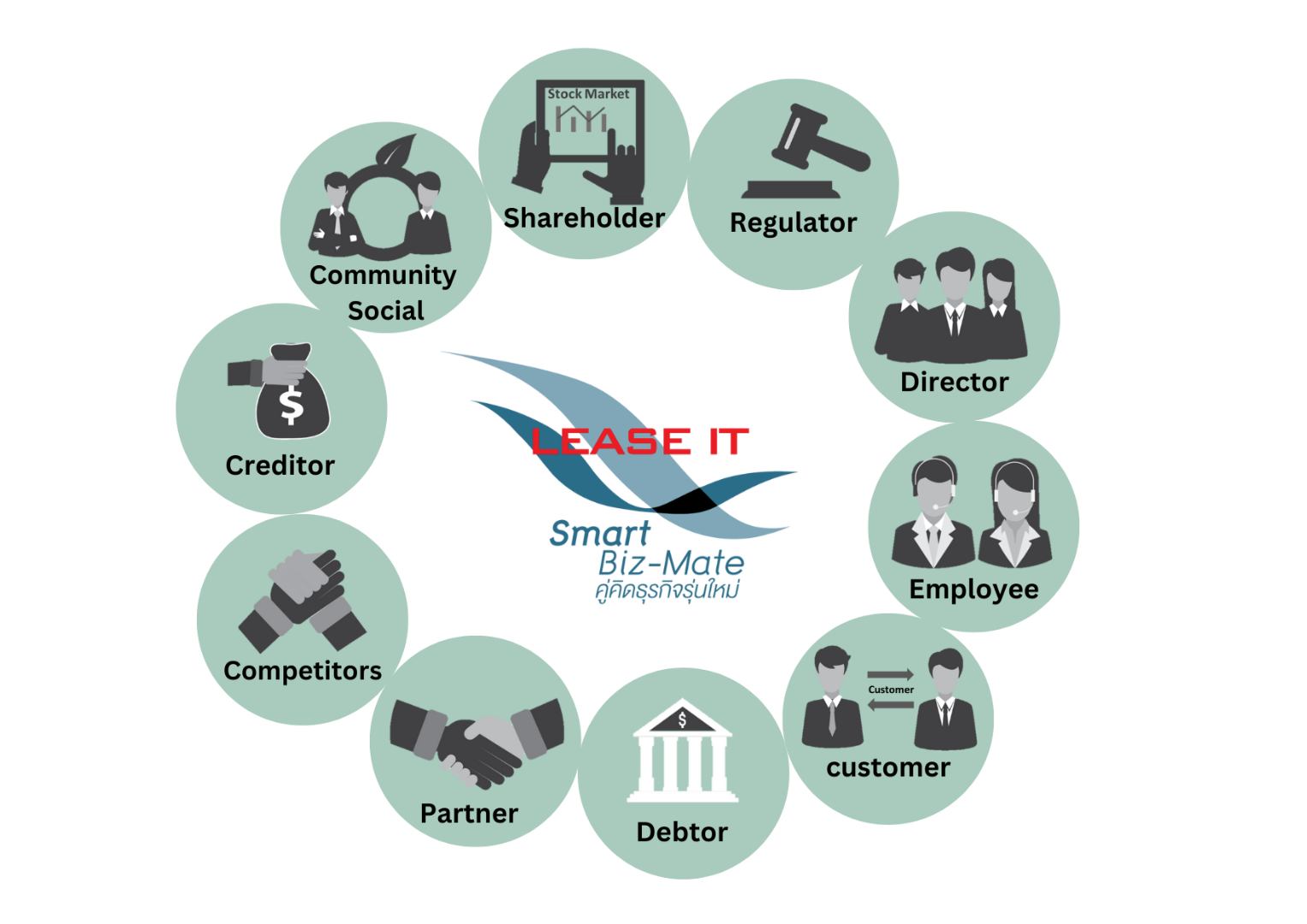
The Company places importance on managing the business value chain (Value Chain), which is a tool to help develop competitive capabilities, reduce risks from doing business In the business operations of the Company. There are main activities and stakeholders involved in the process as follows :
3.Materiality Identification
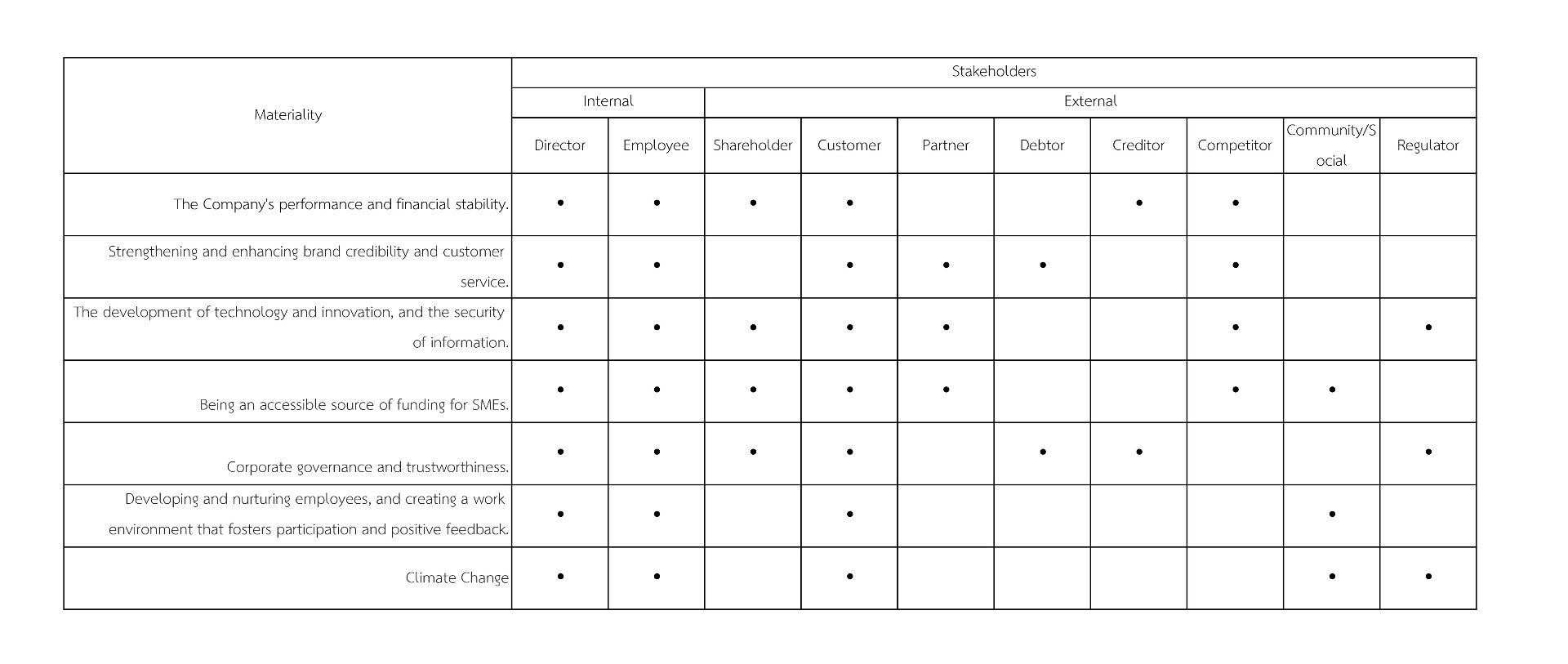
The Company considers the organization strategy and the impact on stakeholders. By Connecting with internal and external stakeholders as follow